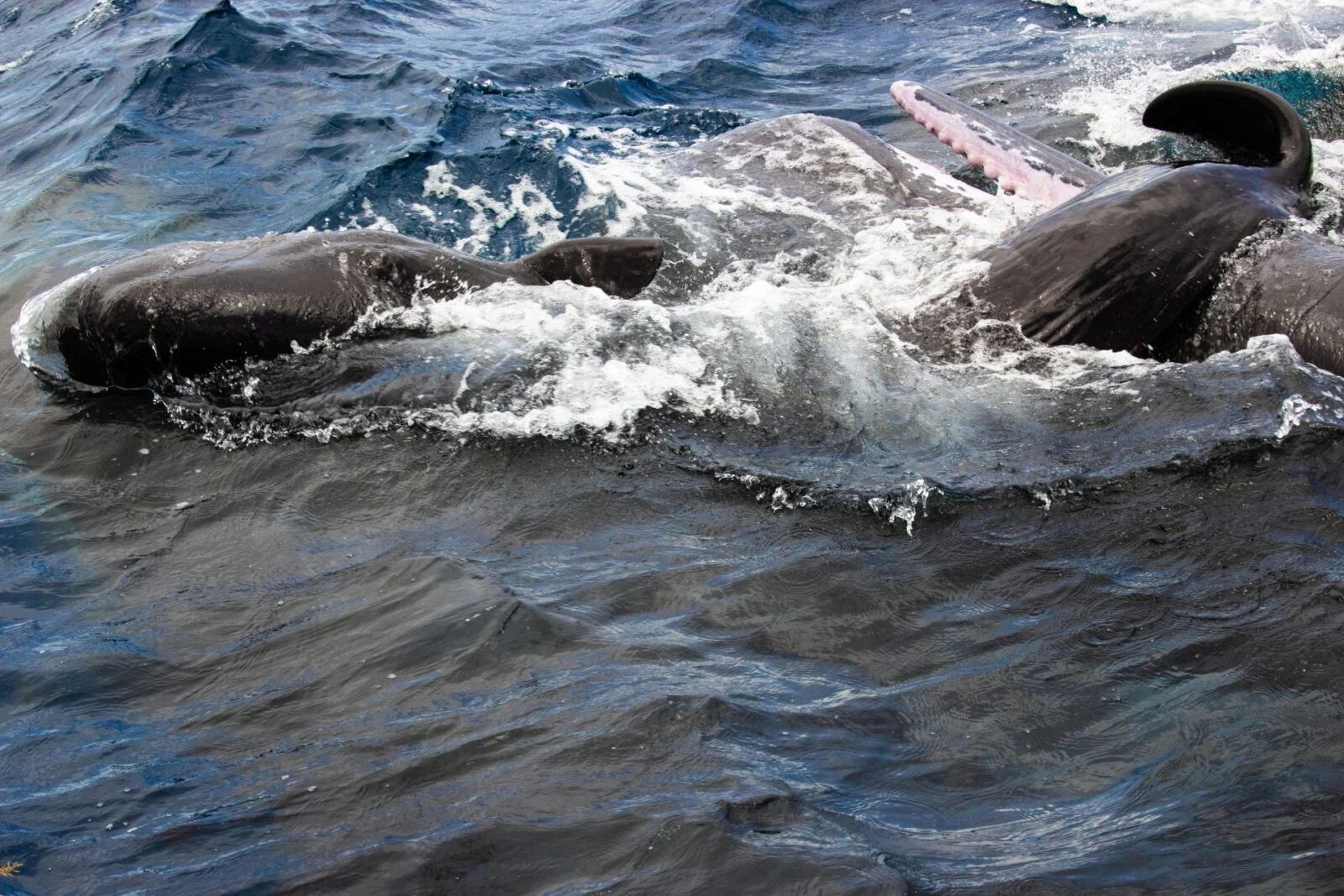
Off the coast of Dominica in July 2023, researchers with Project CETI encountered an unusual sight: 11 sperm whales gathered in a quiet, tight formation near the surface. While these whales typically live in matrilineal groups, this specific gathering included two separate family lines that rarely spend time in such close proximity. What first appeared to be a strangely still moment soon revealed itself as the beginning of a rare biological event—the birth of a new calf.
The mother, a 19-year-old whale named Rounder, began a labor that lasted approximately 34 minutes. In a moment captured by aerial drones, the calf emerged tail-first, an evolutionary adaptation that prevents the newborn from drowning before it can reach the air. As plumes of blood appeared, the surrounding whales did not disperse; instead, they moved into a synchronized formation around the mother and her newborn to provide support.
Sperm whale calves are negatively buoyant at birth, meaning they will sink without immediate physical intervention. To ensure the newborn's survival, every member of the 11-whale group took turns physically lifting the calf to the surface to take its first breaths. This cooperative effort was led by Rounder’s mother, Lady Oracle, and her half-sister, Aurora, but it also notably included Ariel, a young female with no genetic relation to the mother.
For decades, scientists assumed that providing assistance during childbirth was a uniquely human or primate behavior. However, these findings, published in the journals Science and Scientific Reports, suggest that social support during birth is a strategy that may have evolved 35 million years ago in the common ancestors of several toothed whale species. The participation of non-relatives points toward a system of social reciprocity, where the survival of the group is tied to the strength of communal care.
This event underscores a profound truth about the natural world: that complex sociality often emerges from the most vulnerable moments. The fact that these deep-sea giants reorganize their entire social unit to support a single birth suggests a shared experience of care that transcends species. It serves as a reminder that the impulse to assist those in need, even when they are not kin, is a deeply rooted mechanism that sustains complex societies.
A year after the documented birth, the calf was spotted again, healthy and traveling with its family. Its survival through that critical first year is a strong indicator that it will reach adulthood, a success owed to the collective effort of its pod. Project CETI continues to analyze the acoustic data from that day, hoping to further decode the complex vocalizations that coordinated this remarkable display of teamwork.