There is a quiet satisfaction in seeing a decades-long pursuit reach its conclusion. This breakthrough reminds us that even the most familiar points of light in our sky still have stories to tell, and that with enough patience and the right tools, we can eventually see the invisible forces that shape our universe.
On a clear night, the constellation Cassiopeia is easily identified by its distinctive "W" shape. At the center of that formation sits Gamma Cassiopeiae, a star so bright it has been a landmark for navigators and astronomers since it was first classified in 1866. Yet, for the last 50 years, this visible star has harbored a secret: it emits X-rays nearly 40 times stronger than any star of its type should, fueled by plasma burning at a staggering 150 million degrees.
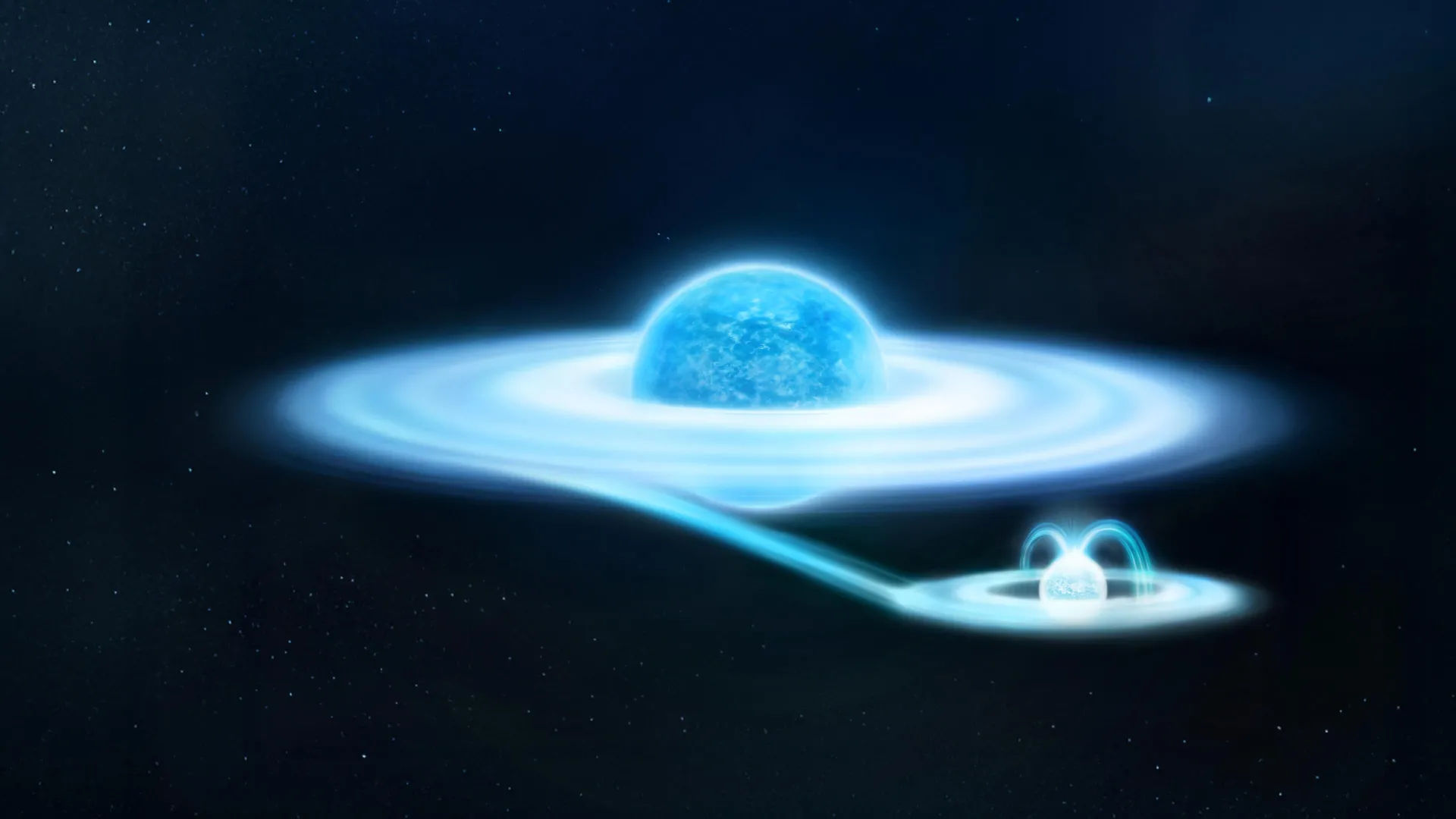
The mystery has finally been resolved through the work of an international team using Japan’s XRISM space telescope. By utilizing a high-precision instrument called Resolve, researchers tracked the star over its 203-day orbital cycle throughout 2024 and 2025. The data revealed that the intense X-ray signals were not coming from the massive blue star itself, but were following the motion of a compact, invisible companion—a magnetic white dwarf.
This "ghostly" companion is a dense, dead remnant of a star that is now siphoning material away from its larger neighbor. As this material is pulled in, the white dwarf’s magnetic field channels the gas toward its poles, where it superheats upon impact. This interaction confirms the existence of a specific type of binary system that astronomers had predicted for decades but had never been able to verify directly until now.
Beyond solving a half-century-old riddle, the discovery provides a vital update to our understanding of how stars evolve in pairs. The findings suggest that these "Be + white dwarf" systems are more common among massive stars than previously thought, which has broader implications for studying the origins of gravitational waves. It appears that the life cycles of the most massive objects in our universe are even more interconnected than our models once suggested.