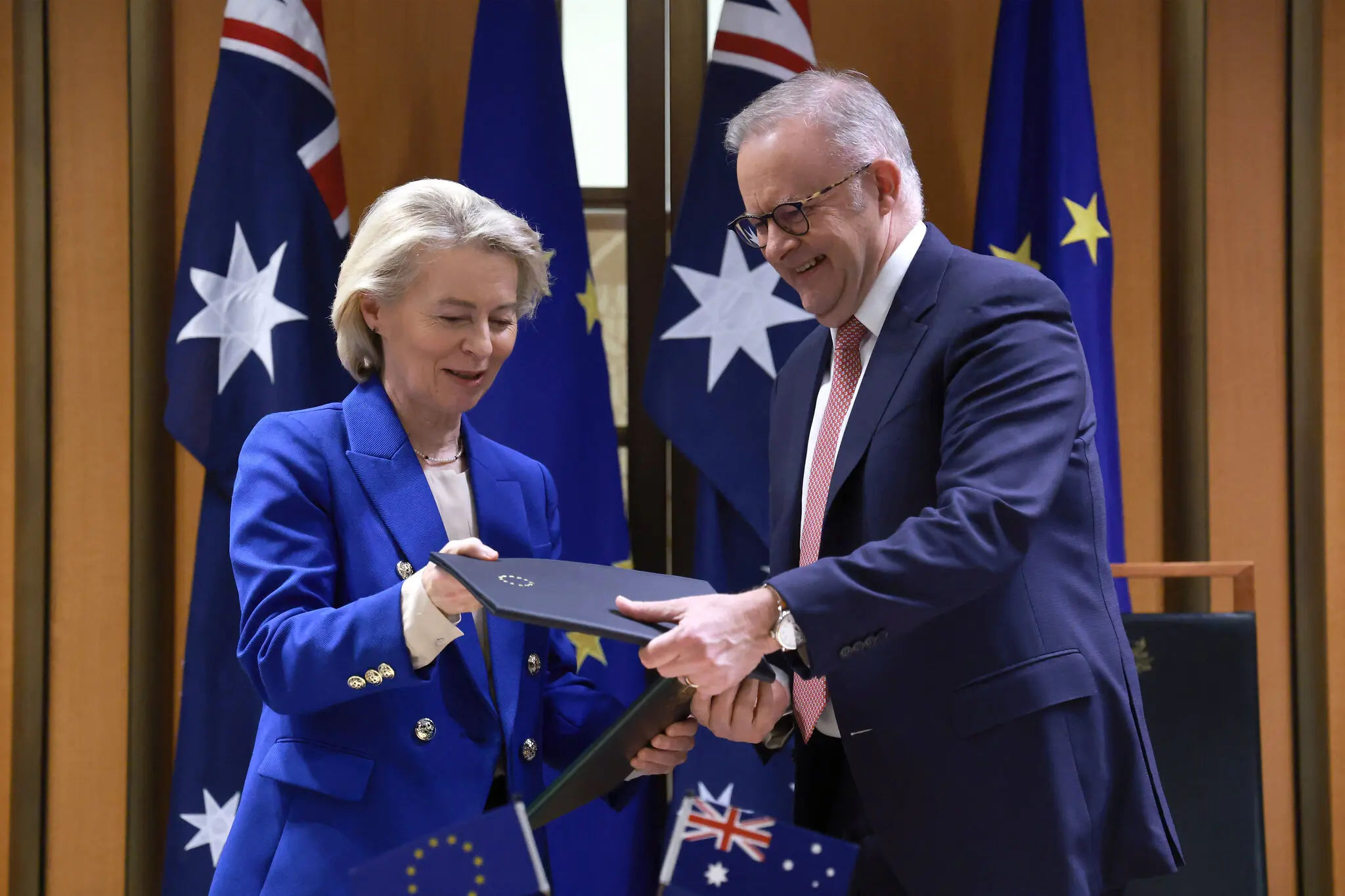
In the quiet halls of Canberra, a handshake between European Commission President Ursula von der Leyen and Australian Prime Minister Anthony Albanese marked the end of eight years of patient negotiation. The newly signed free-trade agreement and security partnership represent more than just a reduction in tariffs; they reflect a conscious choice by two distant partners to prioritize predictability in an era often defined by economic friction. As von der Leyen noted, the agreement tells a story of "positive sum outcomes" in a world where supply chains have increasingly been viewed as vulnerabilities.
The pact is built on a foundation of economic complementarity, linking Australia’s vast natural resources with Europe’s industrial needs. For the European Union, the deal secures vital access to critical minerals like lithium, manganese, and cobalt—the essential building blocks for the continent’s green energy transition and high-tech manufacturing. In return, Australian producers gain deeper access to a market of 450 million consumers, with the agreement set to remove over 99% of tariffs on European exports and bolster the Australian economy by an estimated A$10 billion annually.
Reaching this milestone required a series of careful compromises on culturally and economically sensitive issues. Negotiators found middle ground on agricultural quotas, allowing for a gradual increase in Australian beef and sheep meat exports while maintaining protections for European farmers. Similarly, the deal respects geographical heritage; while Australian winemakers will eventually transition away from using names like "prosecco" for international exports, they have secured the right to continue using terms like "feta" and "gruyere" for products with a long-standing domestic history.
Beyond the exchange of goods, the partnership extends into the realm of collective security. For the first time, Australian companies will be able to participate in the EU’s rearmament programs, fostering a closer defense relationship that includes cooperation on maritime security and emerging technologies like artificial intelligence. This alignment suggests that even across vast geographical distances, shared values regarding a rules-based order can create a "security umbrella" that relies as much on diplomatic trust as it does on military hardware.
This agreement stands out because it moves away from the "transactional" nature of modern geopolitics toward a model of intentional partnership. It highlights a growing trend among "middle powers" to seek stability through diversification rather than over-reliance on any single global superpower. By choosing to bridge their differences through compromise, the EU and Australia have demonstrated that in a changing world, the most durable supply chain is often the one built on mutual respect and shared goals.