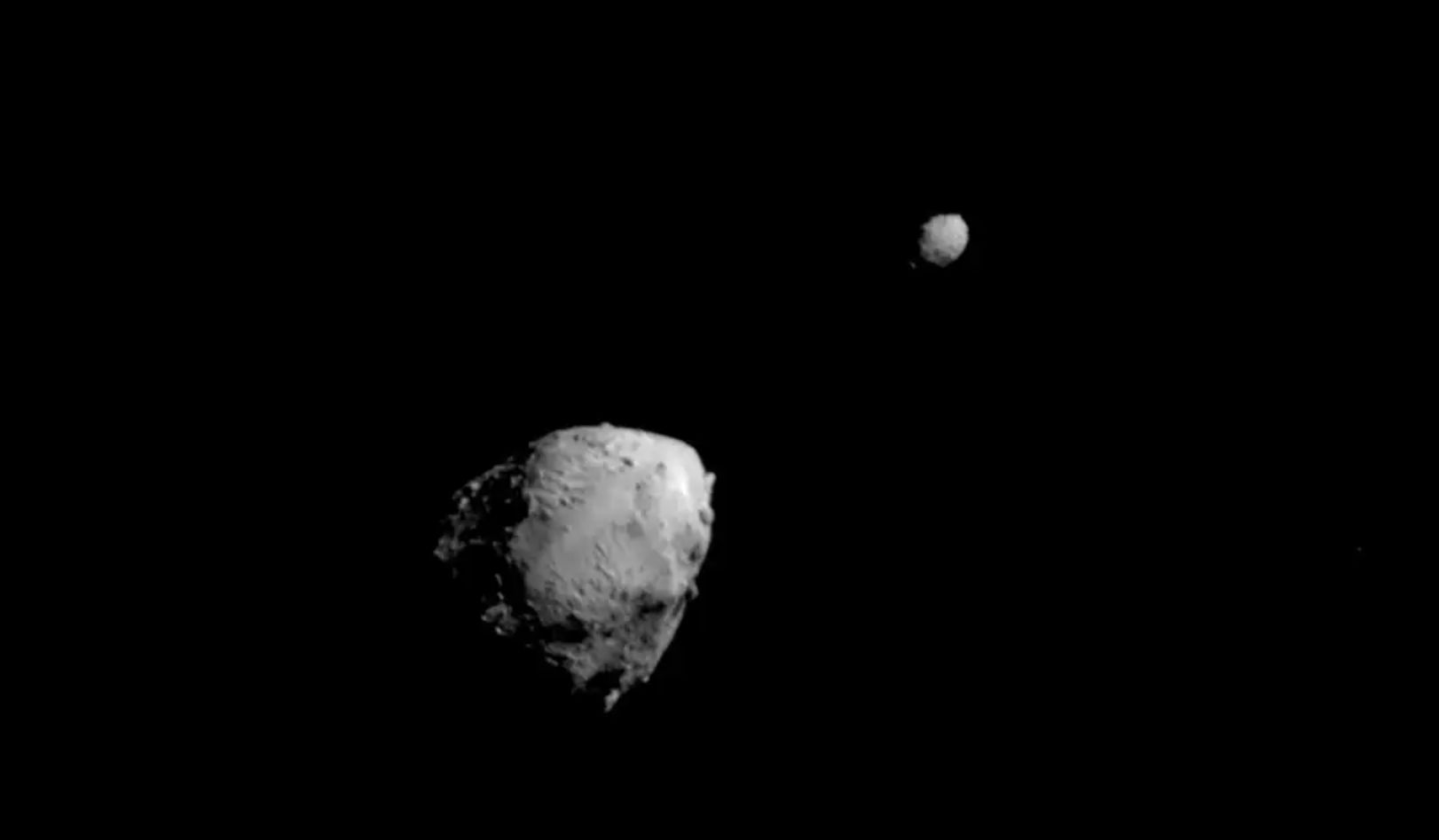
September 2022, a spacecraft roughly the size of a vending machine intentionally collided with Dimorphos, a small moonlet asteroid orbiting a larger companion named Didymos. While the immediate goal of the Double Asteroid Redirection Test (DART) was to nudge the rock within its local system, new data published in Science Advances reveals a more profound result: the impact shifted the entire binary system’s path around the sun. This marks the first time human activity has measurably altered the orbital path of a celestial body.
The shift was facilitated by what scientists call a "momentum enhancement factor." When DART struck Dimorphos, it blasted a massive cloud of rocky debris into space. The force of this material being ejected acted like a secondary engine, providing an explosive thrust that doubled the effectiveness of the spacecraft's impact alone. This recoil slowed the duo's 770-day journey around the sun by approximately 0.15 seconds—a tiny change, but one that confirms humans can influence the motion of objects in deep space.
To detect such a microscopic change, researchers relied on "stellar occultations"—brief moments when an asteroid passes in front of a distant star, causing its light to blink out for a fraction of a second. This effort required a global network of both professional and volunteer astronomers. Some observers traveled to remote regions, including the Australian outback, to record these precise flickers of light. Their collective data allowed scientists to measure the asteroid’s speed and position with exquisite precision, proving that the DART mission’s influence extended far beyond the initial crash site.
This milestone validates the "kinetic impact" technique as a viable strategy for protecting Earth from potential future hazards. Although neither Dimorphos nor Didymos posed a threat to our planet, the experiment proves that even a minuscule change in speed—roughly 1.7 inches per hour—can grow into a significant deflection over time. This provides a clear data point for future efforts, illustrating that if a hazardous object is detected early enough, a targeted strike could ensure it misses Earth entirely.
What stands out in this achievement is the transition of the human role in the solar system from passive observer to active participant. By demonstrating the ability to intentionally steer a celestial body, the mission offers a grounded sense of agency regarding our long-term safety. As NASA develops the Near-Earth Object Surveyor to find harder-to-detect space rocks, the DART results provide a quiet reassurance that the tools to safeguard our shared home are no longer theoretical, but proven.